Choosing between a single CPU vs dual CPU dedicated server affects processing capacity, memory expansion, and hosting costs. Two processors may provide more total cores, but they do not automatically make every application faster.
The right configuration depends on whether your workload benefits from parallel processing or stronger performance per core.
What Is a Single CPU Dedicated Server?
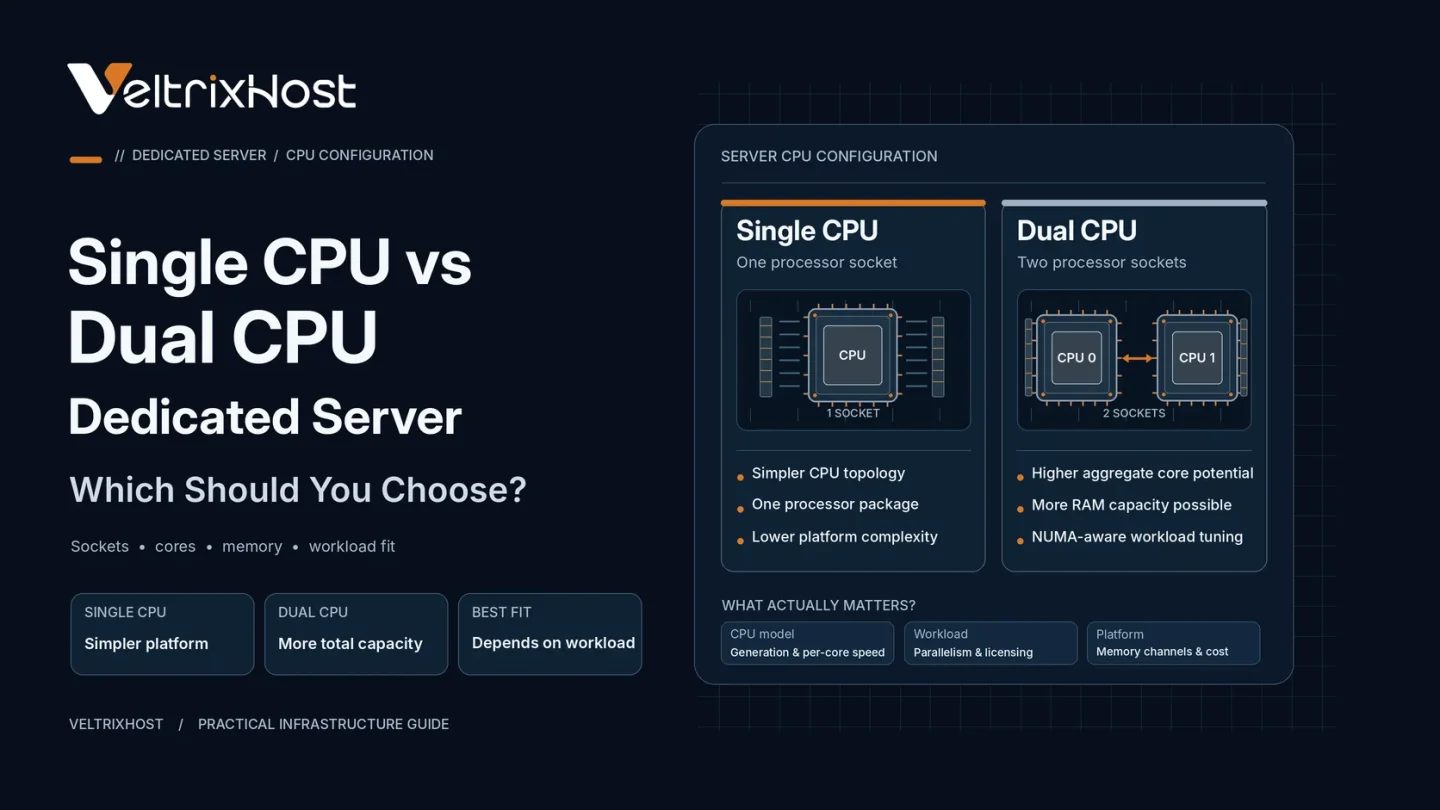
A single CPU dedicated server has one physical processor installed. However, that processor may contain dozens of cores and support substantial RAM.
Single-socket systems can handle websites, game servers, applications, and many databases without the complexity of coordinating two processors.
Modern high-core-count CPUs also make single-socket configurations practical for demanding workloads.
What Is a Dual CPU Dedicated Server?
A dual CPU dedicated server has two physical processors installed on a compatible motherboard.
Together, they can provide more cores, memory channels, and aggregate memory capacity, depending on the hardware.
This configuration benefits virtualization, large databases, parallel computing, and servers running many independent applications.
However, software must use the additional resources efficiently.
Single CPU vs Dual CPU: Key Differences
| Feature | Single CPU | Dual CPU |
|---|---|---|
| Processor sockets | One | Two |
| Total cores | CPU-dependent | Potentially more |
| Memory expansion | Platform-dependent | Often greater |
| Power consumption | Typically lower | Typically higher |
| Configuration | Simpler | NUMA awareness may matter |
| Best suited for | Focused workloads | Parallel workloads |
Does Dual CPU Mean Double Performance?
No. Twice the processors does not guarantee twice the performance.
Applications limited by one processing thread may run faster on a newer single CPU than on two older processors.
Meanwhile, applications that use many processing threads can benefit from additional cores when other resources are sufficient.
Therefore, compare specific processor models, architectures, clock speeds, and benchmark results rather than socket counts alone.
Why Does NUMA Matter?
Dual-socket servers commonly use Non-Uniform Memory Access (NUMA).
Each processor accesses its locally attached memory faster than memory connected to another processor.
Poor thread placement or frequent remote-memory access can increase latency.
Intel’s official NUMA performance guidance explains why processor and memory placement affects performance.
For demanding applications, test NUMA-aware scheduling and monitor actual workload behavior.
When Should You Choose a Single CPU Server?
Single CPU servers are practical for:
- Business websites and web applications.
- Small and medium databases.
- Game hosting and latency-sensitive software.
- Workloads requiring strong per-core performance.
Additionally, single-socket hardware may reduce power consumption and administration complexity.
When Is a Dual CPU Server Better?
Consider dual CPU hardware when hosting numerous virtual machines, running parallel calculations, or managing memory-intensive workloads.
Before purchasing, compare total cores, RAM capacity, NVMe storage, network speed, and software licensing. Some enterprise applications charge per core or processor.
Explore VeltrixHost Dedicated Servers to compare available hardware. Confirm the exact processor count and configuration before ordering.
Final Recommendation
In the single CPU vs dual CPU comparison, a modern single-socket server is often sufficient for straightforward workloads.
Dual CPU servers make sense when additional parallel processing and memory capacity justify their cost.
Choose based on measurable resource requirements, not processor count alone.
FAQs
Is dual CPU always faster than single CPU?
No. Application scalability and individual processor performance determine actual results.
Can a single CPU run multiple virtual machines?
Yes. Available CPU cores, RAM, and storage determine practical capacity.
Does dual CPU improve game server performance?
Not necessarily. Many game workloads depend heavily on individual core performance.
Is dual CPU more expensive?
Often, because of additional processors, power consumption, and potentially higher software licensing costs.