Understanding server latency vs bandwidth helps you choose hosting that delivers reliable website performance. While both affect network connections, they measure different things.
A server with a 10Gbps connection can still feel slow if network latency is high. Likewise, a low-latency server may struggle when too many users compete for limited bandwidth.
The right balance depends on your workload.
What Is Server Latency?
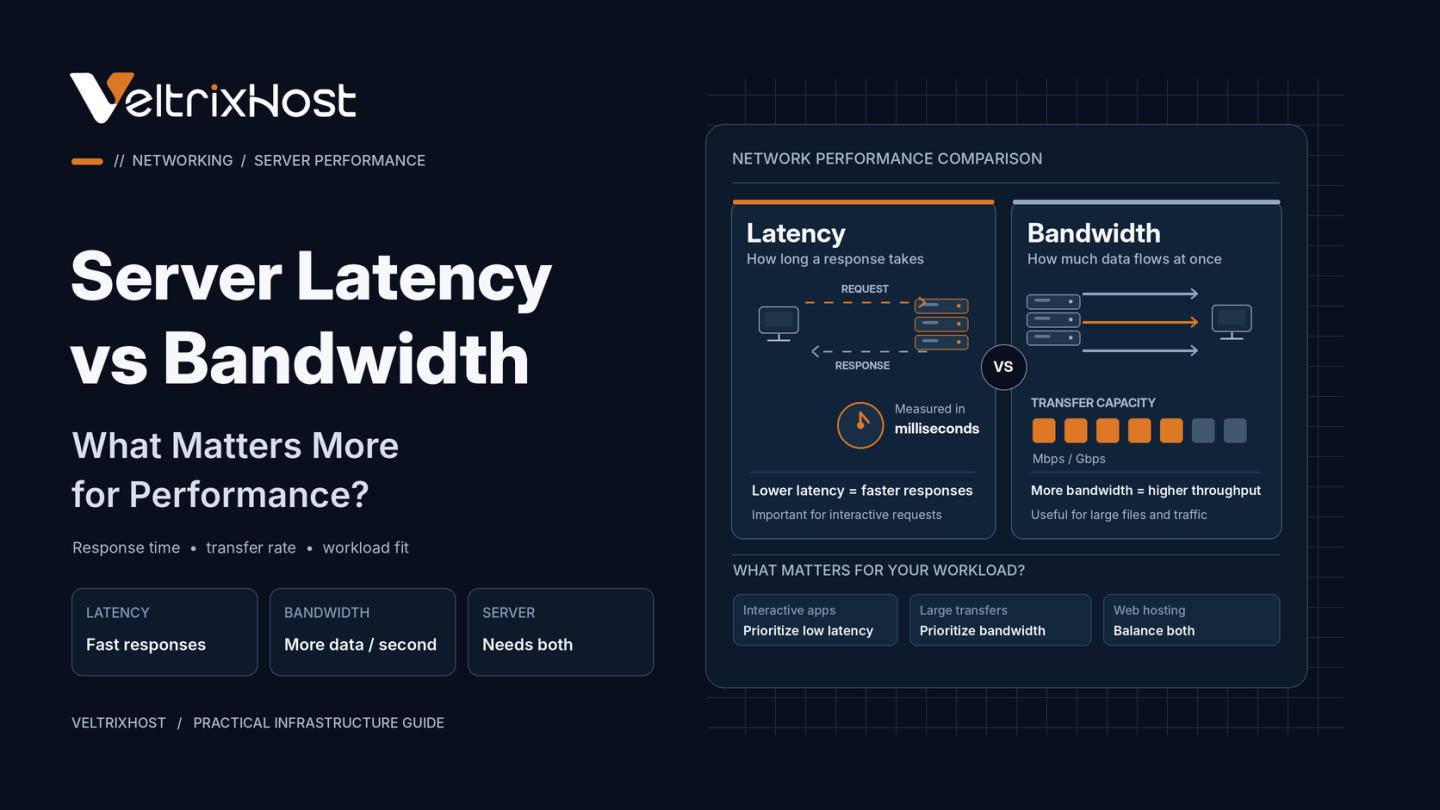
Server latency measures the delay between sending and receiving data across a network. It is commonly expressed in milliseconds (ms).
For example, a 20ms round-trip time generally provides faster network feedback than 150ms, assuming other conditions remain comparable.
Latency depends on physical distance, routing, congestion, and network infrastructure.
Lower latency is particularly important for gaming, interactive applications, remote desktops, and database connections.
What Is Server Bandwidth?
Bandwidth describes the maximum data-transfer rate available through a network connection.
Hosting providers commonly advertise 100Mbps, 1Gbps, or 10Gbps ports.
A 1Gbps connection has a theoretical capacity of approximately 125MB per second. However, actual throughput depends on protocol overhead, congestion, and server performance.
Bandwidth should not be confused with monthly data-transfer allowances, which hosting companies sometimes also call bandwidth.
Server Latency vs Bandwidth: Key Differences
| Feature | Latency | Bandwidth |
|---|---|---|
| Measures | Network delay | Transfer capacity |
| Common units | Milliseconds | Mbps or Gbps |
| Primary impact | Responsiveness | Data throughput |
| Gaming | Very important | Depends on player traffic |
| Large downloads | Affects connection behavior | Often critical |
| Website hosting | Important | Sufficient capacity needed |
Both influence performance, but neither specification tells the complete story.
Which Matters More for Website Performance?
For most websites, low latency improves responsiveness, particularly when browsers make repeated requests.
However, bandwidth becomes important when transferring large images, videos, downloads, or substantial concurrent traffic.
A CDN can reduce latency by serving cached content closer to visitors.
According to Cloudflare’s latency guide, server location, routing, and network infrastructure all influence delay.
When Should You Prioritize Bandwidth?
Higher bandwidth becomes valuable for:
- Video streaming and large file downloads.
- Backup transfers and server replication.
- High-traffic CDN origin servers.
- Applications serving many simultaneous users.
However, purchasing a faster port will not automatically reduce latency.
How to Measure Network Performance
Test your server before upgrading.
Use ping to estimate round-trip time and detect packet loss.
Run mtr to examine network paths and possible routing problems.
For throughput testing, use iperf3 between systems you control.
Monitor performance from locations near your actual visitors. Additionally, review application response times, CPU usage, and storage performance.
Choosing the Right Server Network
Start by identifying your primary audience and workload.
Choose a nearby server location for latency-sensitive applications. For data-heavy services, prioritize sufficient port capacity and monthly transfer.
You can compare available regions and network configurations through VeltrixHost Server Network.
Final Recommendation
In the server latency vs bandwidth comparison, low latency generally matters more for interactive responsiveness, while bandwidth matters more for large transfers and concurrent traffic.
For balanced performance, evaluate both alongside routing quality, packet loss, and server resources.
FAQs
Is lower latency better than higher bandwidth?
For interactive applications, often yes. Large downloads and streaming may benefit more from additional bandwidth.
Does 10Gbps reduce server latency?
Not automatically. Port speed and network delay are separate measurements.
What is good server latency?
It depends on application requirements and user location. Lower, stable round-trip times are generally preferable.
Can a CDN reduce latency?
Yes. CDN edge servers can deliver cached content closer to visitors, reducing network distance.