Choosing between high availability vs vertical scaling becomes important when your VPS or dedicated server struggles with growing traffic or downtime. Both approaches improve infrastructure, but they solve different problems.
Vertical scaling increases server capacity. High availability focuses on keeping applications accessible during failures. Understanding the difference helps you avoid unnecessary upgrades and costly interruptions.
What Is Vertical Scaling?
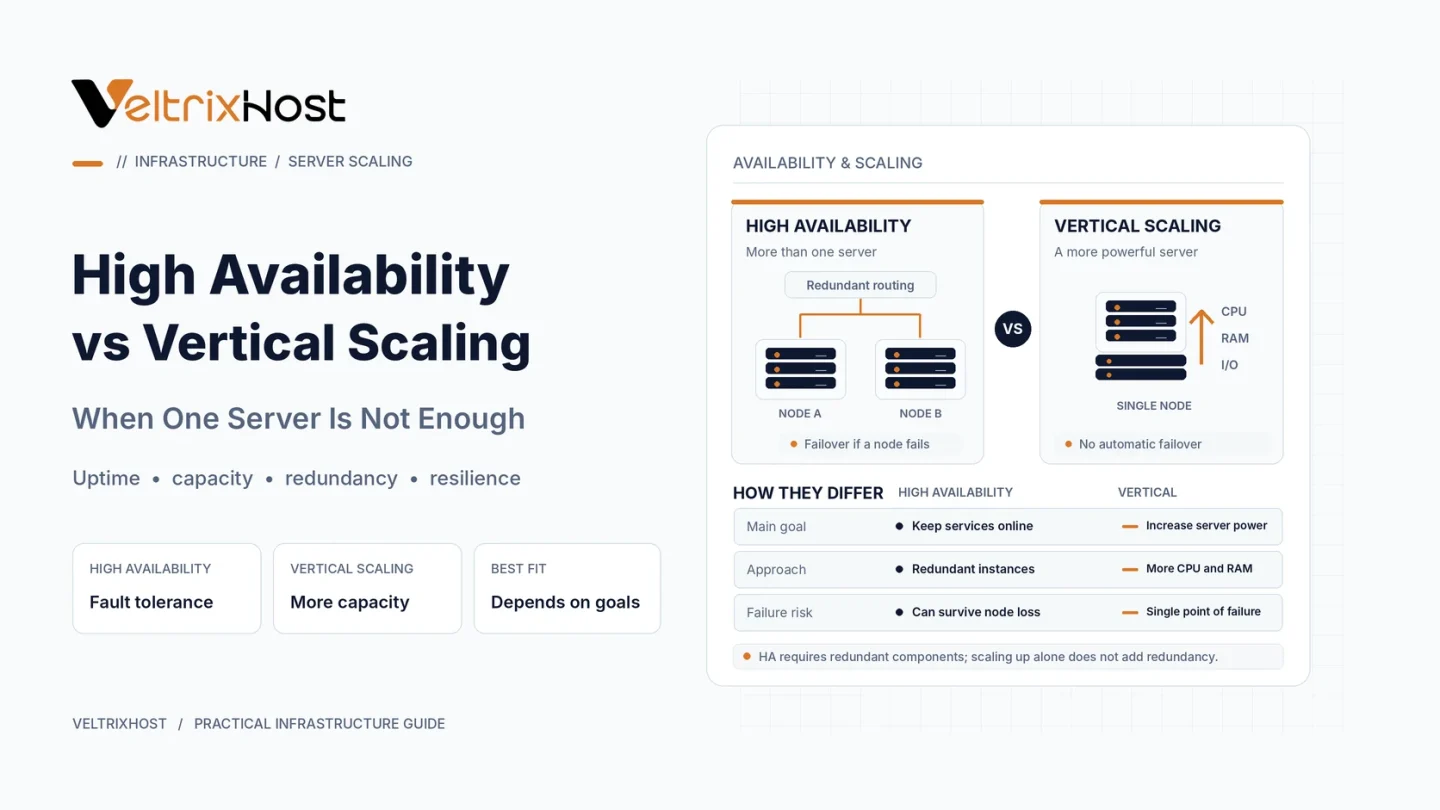
Vertical scaling, also called scaling up, means adding CPU, RAM, or storage to an existing server.
For example, upgrading a VPS from 4GB to 8GB RAM may improve database performance and support more concurrent processes.
This approach is straightforward because applications usually remain on one server. However, upgrades can require restarts, and physical hardware limits eventually restrict further growth.
Most importantly, one powerful server can still fail.
What Is High Availability?
High availability (HA) uses redundant infrastructure to reduce service interruptions.
Instead of depending entirely on one server, applications can operate across multiple systems with health checks and failover mechanisms.
For example, two application servers behind a load balancer may continue serving visitors if one fails.
However, effective HA also requires attention to databases, shared storage, networking, and application state.
Simply adding another server does not automatically create high availability.
High Availability vs Vertical Scaling: Key Differences
| Feature | Vertical Scaling | High Availability |
|---|---|---|
| Primary goal | Increase capacity | Reduce downtime |
| Server count | Usually one | Usually multiple |
| Hardware failure | Service may stop | Failover may help |
| Configuration | Simpler | More complex |
| Costs | Upgrade-dependent | Additional infrastructure |
| Best suited for | Resource bottlenecks | Critical applications |
When Should You Scale Vertically?
Vertical scaling makes sense when your application needs additional resources but does not require distributed infrastructure.
Common examples include:
- WordPress websites approaching RAM limits.
- Databases needing larger memory caches.
- Applications experiencing sustained CPU saturation.
- Small businesses expecting predictable traffic growth.
Before upgrading, check CPU usage, memory pressure, database queries, and disk performance.
Adding hardware will not resolve inefficient application code automatically.
When Do You Need High Availability?
Consider HA when downtime causes significant revenue loss, disrupts customers, or violates service commitments.
Business-critical websites, SaaS platforms, ecommerce systems, and essential APIs often benefit from redundancy.
A typical setup may include multiple application servers, load balancing, database replication, and automated health monitoring.
However, database failover requires careful consistency management. Additionally, redundant servers should avoid sharing the same critical failure points.
Microsoft’s reliable scaling guidance explains how vertical and horizontal scaling support different infrastructure needs.
Can You Combine Both Approaches?
Yes. In fact, many production environments benefit from combining them.
You might increase RAM on existing servers while running multiple application instances for failover.
However, high availability adds operational complexity. Monitor failure detection, recovery time, and data synchronization before expanding.
Choosing the Right Hosting Infrastructure
Start with your workload, availability requirements, and budget.
For applications that need more capacity, compare VeltrixHost Linux VPS Hosting plans with different CPU and RAM allocations.
For HA, confirm that your chosen infrastructure supports multiple independent servers, suitable networking, and reliable backup arrangements.
Final Recommendation
In the high availability vs vertical scaling comparison, choose vertical scaling when capacity is your main limitation.
Choose high availability when service continuity is essential.
If both performance and uptime matter, combine appropriate server resources with properly tested redundancy.
FAQs
Does vertical scaling improve uptime?
Not automatically. A larger server can still experience hardware, software, or network failures.
Is high availability the same as load balancing?
No. Load balancing distributes traffic, while HA also requires redundancy and reliable failover.
Can two VPS servers provide high availability?
Yes, if they use appropriate failover, data synchronization, and independent infrastructure.
Is high availability expensive?
It generally costs more because additional servers, monitoring, and management are required.