Choosing between NVIDIA H100 vs H200 is important when building infrastructure for large language models (LLMs), AI training, and high-performance computing. Both GPUs use NVIDIA’s Hopper architecture, but they differ significantly in memory capacity and bandwidth.
Understanding these differences helps you select the right GPU server without paying for resources your applications cannot use.
What Is the NVIDIA H100?
The NVIDIA H100 is a data center GPU designed for AI training, inference, and scientific computing.
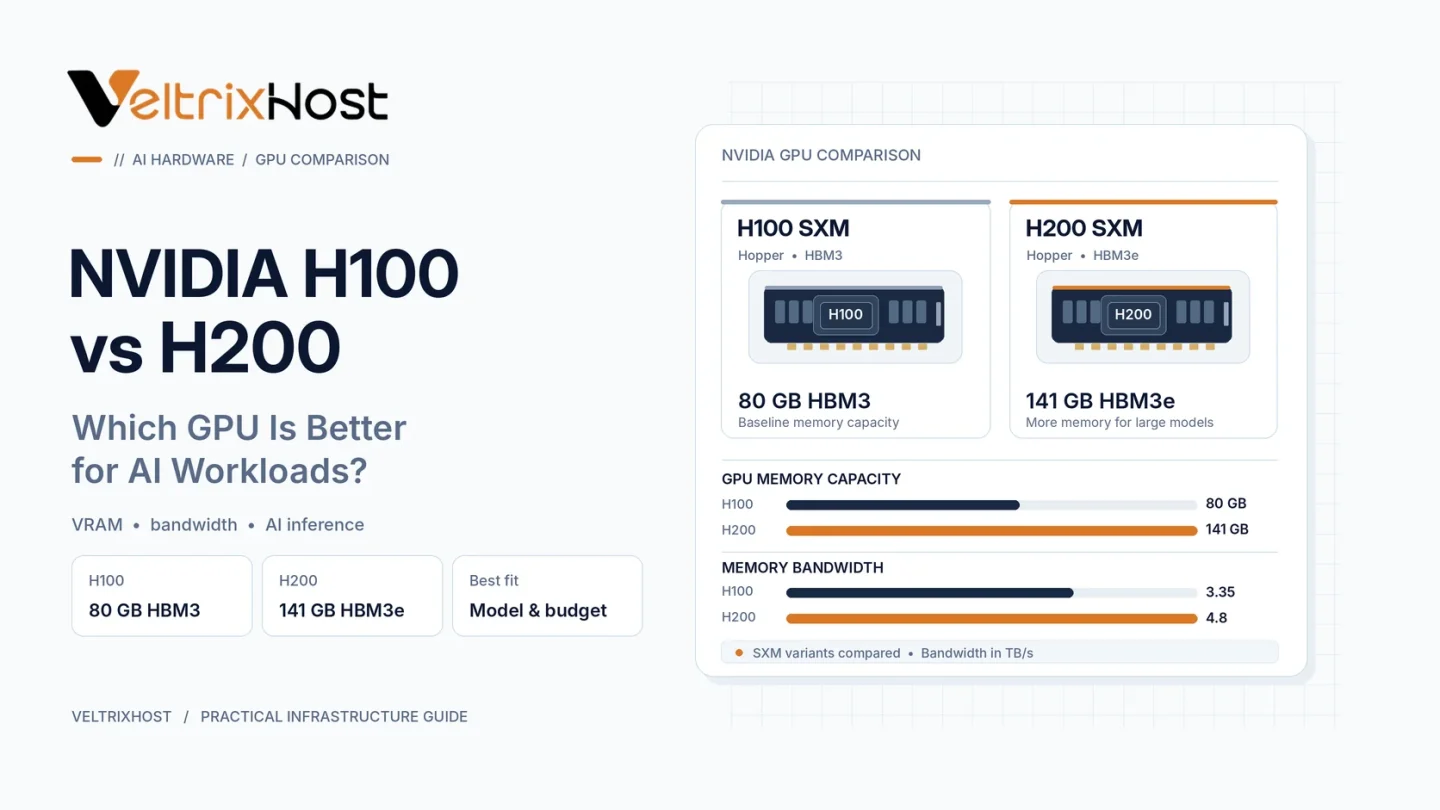
It supports Tensor Cores, FP8 precision, and high-speed GPU interconnections. The H100 SXM configuration includes 80GB of HBM3 memory with 3.35TB/s memory bandwidth.
These capabilities make it suitable for model fine-tuning, inference services, and demanding computational workloads.
What Is the NVIDIA H200?
The NVIDIA H200 builds on the same Hopper architecture but introduces faster HBM3e memory.
Its SXM configuration provides 141GB of GPU memory and 4.8TB/s bandwidth.
This additional capacity helps accommodate larger models, longer context windows, and more concurrent inference requests.
However, the H200 does not automatically outperform the H100 in every application.
NVIDIA H100 vs H200: Key Differences
| Specification | H100 SXM | H200 SXM |
|---|---|---|
| Architecture | Hopper | Hopper |
| GPU memory | 80GB | 141GB |
| Memory technology | HBM3 | HBM3e |
| Memory bandwidth | 3.35TB/s | 4.8TB/s |
| FP8 support | Yes | Yes |
| NVLink bandwidth | 900GB/s | 900GB/s |
| Main advantage | Capable AI compute | Larger, faster memory |
These specifications compare SXM models. Other variants have different configurations.
Which GPU Is Better for LLM Inference?
The H200 is particularly attractive for memory-intensive LLM inference.
Larger VRAM capacity can reduce the need to distribute models across GPUs. Additionally, higher memory bandwidth can improve throughput when memory access limits performance.
For example, a 70-billion-parameter model needs approximately 140GB for BF16 weights alone. Runtime overhead and KV cache require additional memory, so even 141GB may be insufficient without optimization.
Meanwhile, H100 remains useful for smaller models, quantized inference, and workloads that fit comfortably within its memory.
Which GPU Is Better for AI Training?
Both GPUs support demanding training and fine-tuning workloads.
The H200 may provide advantages when larger models, activations, or training batches increase memory pressure.
However, GPU compute capability, interconnect configuration, software optimization, and distributed training efficiency also affect results.
Review NVIDIA’s H200 specifications before comparing hardware configurations.
Is the H200 Worth the Extra Cost?
The answer depends on pricing and workload requirements.
Choose H100 when its memory capacity is sufficient and its overall deployment cost is more attractive.
Consider H200 when larger model memory, higher inference throughput, or reduced multi-GPU complexity justifies the premium.
For deployment options, compare VeltrixHost GPU Dedicated Servers and confirm current accelerator availability.
Final Recommendation
In the NVIDIA H100 vs H200 comparison, H200 is generally the stronger choice for memory-demanding AI workloads.
However, H100 can deliver excellent value when workloads fit its available VRAM.
Benchmark your model, precision, context length, and concurrent requests before deciding.
FAQs
Is H200 faster than H100?
Often for memory-bound workloads, but actual performance depends on the application and configuration.
Does H200 have more VRAM?
Yes. H200 SXM provides 141GB compared with H100 SXM’s 80GB.
Is H100 still suitable for AI?
Yes. H100 remains capable for LLM inference, training, and fine-tuning.
Can H200 run larger language models?
Its greater memory capacity helps, although model precision and runtime overhead determine whether a model fits.