Choosing between Mailcow vs iRedMail matters when building a self-hosted email server. Both combine SMTP delivery, mailboxes, webmail, and spam protection, but they differ in installation, administration, and resource requirements.
The right platform depends on your Linux experience, available VPS memory, and whether you need team collaboration features.
What Is Mailcow?
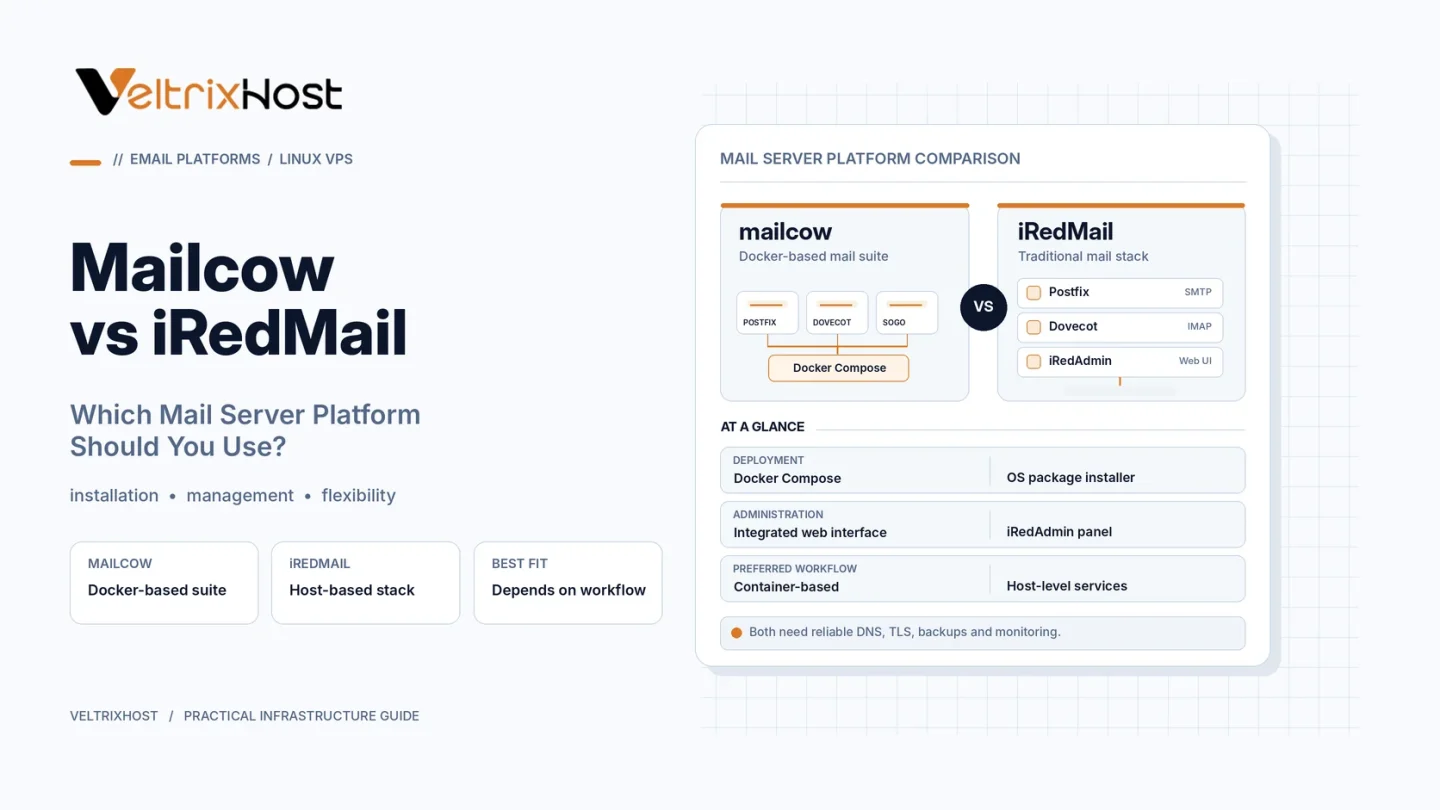
Mailcow is a Docker-based mail and groupware suite. It combines Postfix, Dovecot, Rspamd, SOGo webmail, and other services behind a web administration interface.
Its integrated approach suits administrators who want to manage domains, mailboxes, DKIM keys, and spam policies from one dashboard. However, its containers and optional scanning services require sufficient memory.
What Is iRedMail?
iRedMail builds a complete mail server using established open-source components, including Postfix and Dovecot.
The classic open-source edition uses an installation script, while iRedMail Enterprise Edition adds web-based deployment, management, and simplified upgrades. Enterprise features have licensing considerations, so compare editions before selecting one.
Mailcow vs iRedMail: Key Differences
| Feature | Mailcow | iRedMail |
|---|---|---|
| Deployment | Docker Compose | Traditional installer; Enterprise options |
| Administration | Integrated web interface | Depends on edition |
| Webmail and groupware | SOGo included | Roundcube or SOGo options |
| Spam protection | Integrated tools | Integrated tools |
| Updates | Container-based update process | Edition-dependent process |
| Best fit | Docker-friendly teams | Flexible Linux/BSD deployments |
Which Platform Needs More VPS Resources?
Mailcow’s default installation requires at least 6 GiB RAM and 1 GiB swap, plus 20 GiB disk space before mailbox storage. Its documentation recommends 8 GiB RAM for approximately five to ten users.
iRedMail Enterprise documentation describes 4 GB RAM as a starting minimum for a low-traffic production server with spam and virus scanning. Requirements increase with SOGo, mailbox counts, and concurrent clients.
Neither figure represents a guaranteed capacity. Allow additional storage for email, backups, logs, and database growth.
Which Is Easier to Maintain?
Mailcow makes sense if you are comfortable with Docker and want a consolidated interface. Its integrated services simplify some setup tasks, but backups must protect databases, mail volumes, and encryption keys.
iRedMail may appeal to administrators who prefer a traditional system installation. For new deployments, its developers recommend Enterprise Edition. Check the official iRedMail Enterprise comparison for features and licensing.
Both require security updates, TLS, SPF, DKIM, DMARC, valid reverse DNS, and ongoing deliverability monitoring.
Choosing an SMTP VPS
Before installing either platform, check RAM, CPU, disk capacity, compatible operating systems, and available mail ports.
VeltrixHost SMTP VPS Hosting offers self-managed Linux VPS plans with root access, dedicated IPv4, outbound Port 25, and PTR/rDNS controls. Choose a plan that meets your platform’s complete system requirements.
Final Recommendation
For Mailcow vs iRedMail, choose Mailcow if you prefer a Docker-managed groupware suite. Consider iRedMail when you want its installer, administration options, or supported operating systems.
Test both platforms against your maintenance skills and mailbox workload before migrating production email.
FAQs
Is Mailcow better for beginners?
Its web interface can simplify administration, but you still need Docker, DNS, and mail-server knowledge.
Can iRedMail run on a Linux VPS?
Yes, provided the operating system, memory, storage, and network settings meet its requirements.
Does either platform guarantee inbox delivery?
No. Authentication, IP reputation, recipient policies, and sending practices still determine outcomes.