Understanding Anycast vs Unicast helps you choose the right network architecture for websites, DNS services, and dedicated servers. Both deliver internet traffic, but they determine the destination differently.
For hosting providers and website owners, this distinction can affect latency, resilience, and traffic distribution.
What Is Unicast Networking?
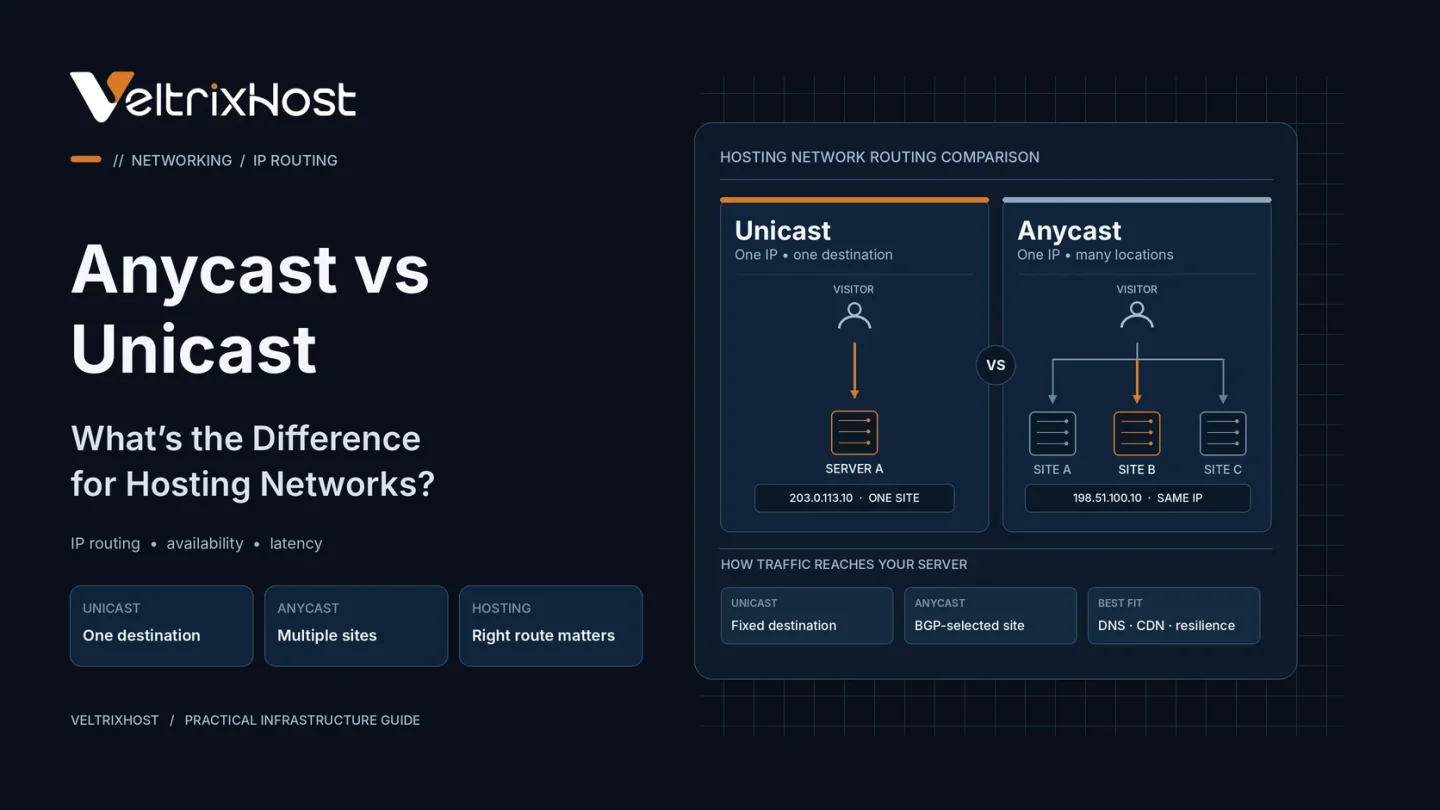
Unicast is the conventional method of sending packets from one source to a specific destination IP address.
For example, visitors connecting directly to a VPS typically reach the server associated with its public IP.
Unicast works well for websites, databases, gaming servers, and applications requiring a predictable destination.
However, distributing users across several locations requires additional mechanisms, such as DNS-based routing or load balancing.
What Is Anycast Networking?
Anycast allows multiple servers or network locations to advertise the same service IP address.
Internet routing selects one available location based on network topology and routing policies, commonly using Border Gateway Protocol (BGP).
For example, an Anycast DNS service may answer requests from different data centers while using the same public IP.
Importantly, Anycast does not guarantee the geographically closest destination. Routing policies and internet connectivity influence the selected path.
Anycast vs Unicast: Key Differences
| Feature | Unicast | Anycast |
|---|---|---|
| IP destination | Specific endpoint | Shared across locations |
| Traffic routing | To designated destination | To a selected service location |
| Geographic distribution | Requires additional routing | Built into deployment |
| Failover | Requires separate mechanisms | Routing can shift to another node |
| Common applications | VPS, databases, origin servers | DNS, CDNs, edge services |
How Does Anycast Affect Hosting Performance?
Lower Latency Potential
Anycast can bring requests closer to users in network terms, potentially reducing connection delays.
However, performance depends on peering relationships, routing decisions, and available infrastructure.
Improved Network Resilience
When an Anycast location becomes unavailable and its route is withdrawn, traffic can shift toward another advertised location.
Failover is not always immediate, and existing connections may disconnect.
DDoS Traffic Distribution
Anycast can spread incoming attacks across multiple network locations, helping prevent one site from carrying the entire load.
However, protection still requires adequate network capacity and filtering systems.
What Are the Limitations of Anycast?
Anycast adds operational complexity.
Applications that maintain long-lived connections or store session information locally may encounter problems when routing changes.
Operators must consider synchronization, connection handling, monitoring, and routing stability.
The official IETF Anycast Architecture Guide explains these challenges.
When Should You Choose Unicast?
Unicast is usually appropriate when running a VPS, dedicated server, database, or application hosted in one location.
It offers straightforward routing and a predictable infrastructure design.
For a global audience, you can combine a Unicast origin with an Anycast CDN or DNS provider instead of deploying your own Anycast network.
How to Choose a Hosting Network
Before selecting a hosting provider, evaluate:
- Audience location: Identify where most visitors connect.
- Latency: Test response times from relevant regions.
- Bandwidth: Compare port speed and traffic allowances.
- Reliability: Review failover and DDoS protection arrangements.
Explore VeltrixHost Network Locations to compare regional server availability and network-speed options.
Final Recommendation
For Anycast vs Unicast, choose Unicast for straightforward server hosting and dedicated application endpoints.
Consider Anycast for geographically distributed DNS, CDN, and edge services where availability and regional performance matter.
Remember that effective routing, infrastructure quality, and application design matter more than the addressing method alone.
FAQs
Is Anycast faster than Unicast?
Sometimes. Anycast may reduce latency, but routing conditions determine actual performance.
Does Anycast prevent DDoS attacks?
Not automatically. It distributes traffic, while filtering and sufficient capacity remain essential.
Can a VPS use Anycast?
Yes, with suitable routing infrastructure, although ordinary VPS hosting typically uses Unicast addressing.