Understanding IPv4 vs IPv6 for VPS hosting is important when choosing a server for your website, application, or online business. Both protocols allow devices to communicate over the internet, but they differ in address capacity, compatibility, and network configuration.
In 2026, website owners should understand these differences before choosing between IPv4-only, IPv6-only, and dual-stack VPS hosting.
What Is IPv4?
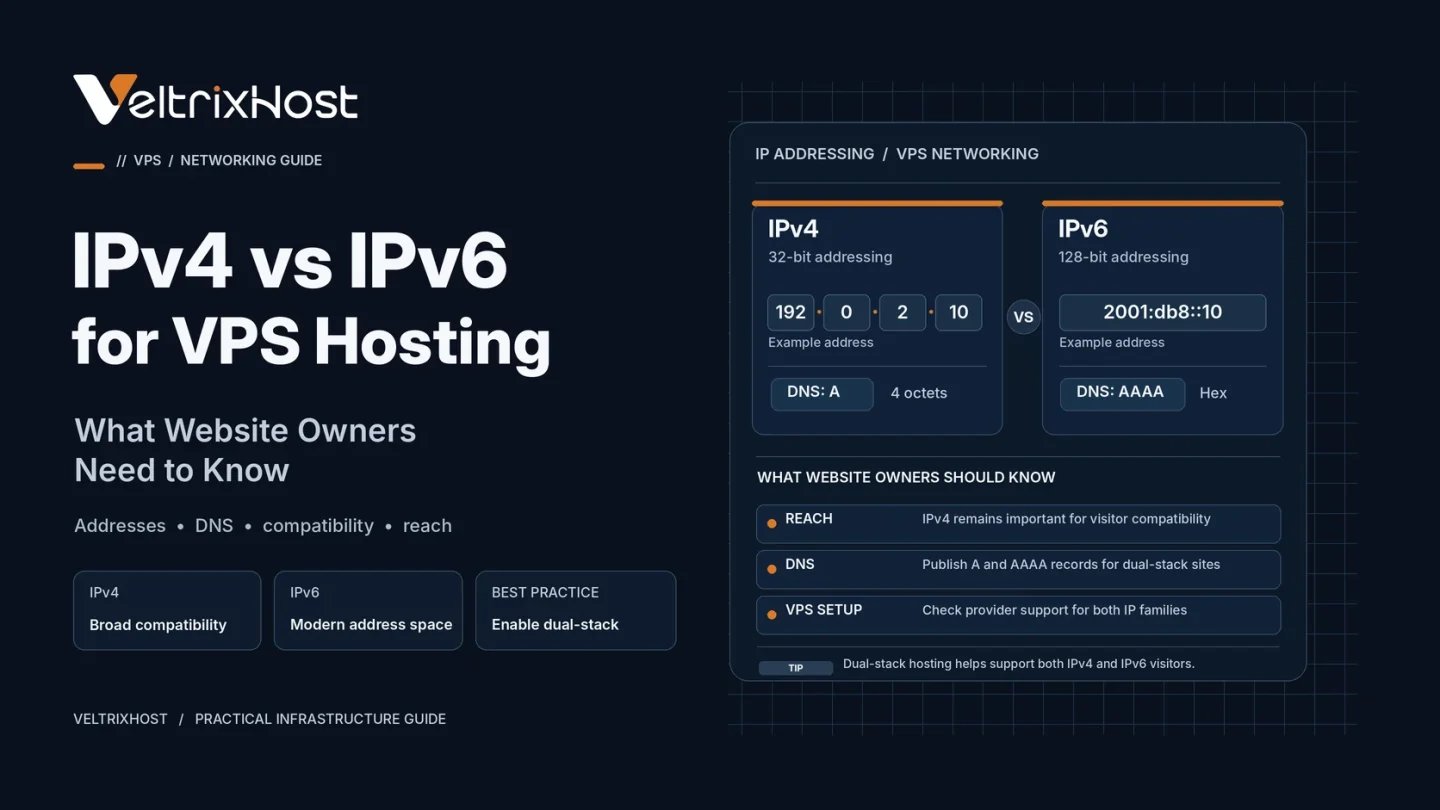
IPv4 (Internet Protocol version 4) uses 32-bit addresses, providing approximately 4.3 billion unique address combinations.
A typical IPv4 address looks like 192.0.2.10.
IPv4 remains widely supported by internet providers, browsers, hosting platforms, and business applications.
However, its limited address space has contributed to address scarcity and additional allocation costs. Some hosting providers therefore charge separately for extra IPv4 addresses.
What Is IPv6?
IPv6 uses 128-bit addresses, providing a vastly larger address space.
An example IPv6 address is 2001:db8::10.
IPv6 supports modern internet growth without depending on widespread IPv4 address sharing.
However, IPv6-only websites and services may remain inaccessible to users or systems without compatible connectivity or translation mechanisms.
IPv4 vs IPv6 for VPS Hosting: Key Differences
| Feature | IPv4 | IPv6 |
|---|---|---|
| Address length | 32-bit | 128-bit |
| Address availability | Limited | Vast |
| Compatibility | Widely supported | Growing adoption |
| DNS record | A | AAAA |
| Additional address costs | Often higher | Usually lower |
| Speed | Network-dependent | Network-dependent |
| Security | Requires configuration | Requires configuration |
Neither protocol automatically guarantees faster connections or stronger server security.
Which Is Better for Website Hosting?
For most public websites, dual-stack hosting is the practical choice.
A dual-stack VPS supports both IPv4 and IPv6 connections, allowing compatible visitors to reach your website through either protocol.
IPv4 helps maintain accessibility for older networks and applications, while IPv6 supports modern connectivity.
Additionally, hosting both protocols can reduce compatibility concerns as IPv6 adoption continues.
How to Configure IPv4 and IPv6 on a VPS
After deploying your server, follow these steps:
- Confirm that your hosting provider has assigned working IPv4 and IPv6 addresses.
- Configure your web server to listen on both protocols.
- Add a DNS A record pointing to your IPv4 address.
- Add a DNS AAAA record pointing to your IPv6 address.
- Allow the required traffic through IPv4 and IPv6 firewall rules.
- Test HTTPS connectivity separately over each protocol.
For a detailed explanation, consult Cloudflare’s official DNS A and AAAA record documentation.
Do not publish an AAAA record until your server is reachable over IPv6.
Does IPv6 Improve VPS Performance or SEO?
IPv6 does not automatically improve website speed or search rankings.
Actual performance depends on network routing, latency, server resources, caching, and application optimization.
Likewise, search visibility depends primarily on accessible, crawlable content and established SEO practices rather than the IP protocol itself.
Choose IPv6 for connectivity and scalability, not as a guaranteed performance upgrade.
Choosing a VPS With IPv4 and IPv6
Before purchasing, confirm address availability, firewall support, DNS configuration options, and compatibility with your applications.
VeltrixHost Linux VPS Hosting includes IPv4 and IPv6 addressing, KVM virtualization, and full root access for configuring websites and applications.
Final Recommendation
In the IPv4 vs IPv6 for VPS hosting comparison, dual-stack support offers the best balance for most website owners.
Keep IPv4 compatibility while enabling IPv6 correctly. Test both connections and monitor network reliability before launching production services.
FAQs
Do I need IPv6 for my VPS?
Not necessarily, but IPv6 support helps prepare your website for modern networks.
Can a VPS run IPv4 and IPv6 together?
Yes. Dual-stack VPS hosting allows both protocols to operate simultaneously.
Is IPv6 faster than IPv4?
Not always. Routing quality, network conditions, and infrastructure determine actual performance.
Can I host a website using only IPv6?
Yes, but IPv4-only visitors may need a compatible proxy or translation service to access it.