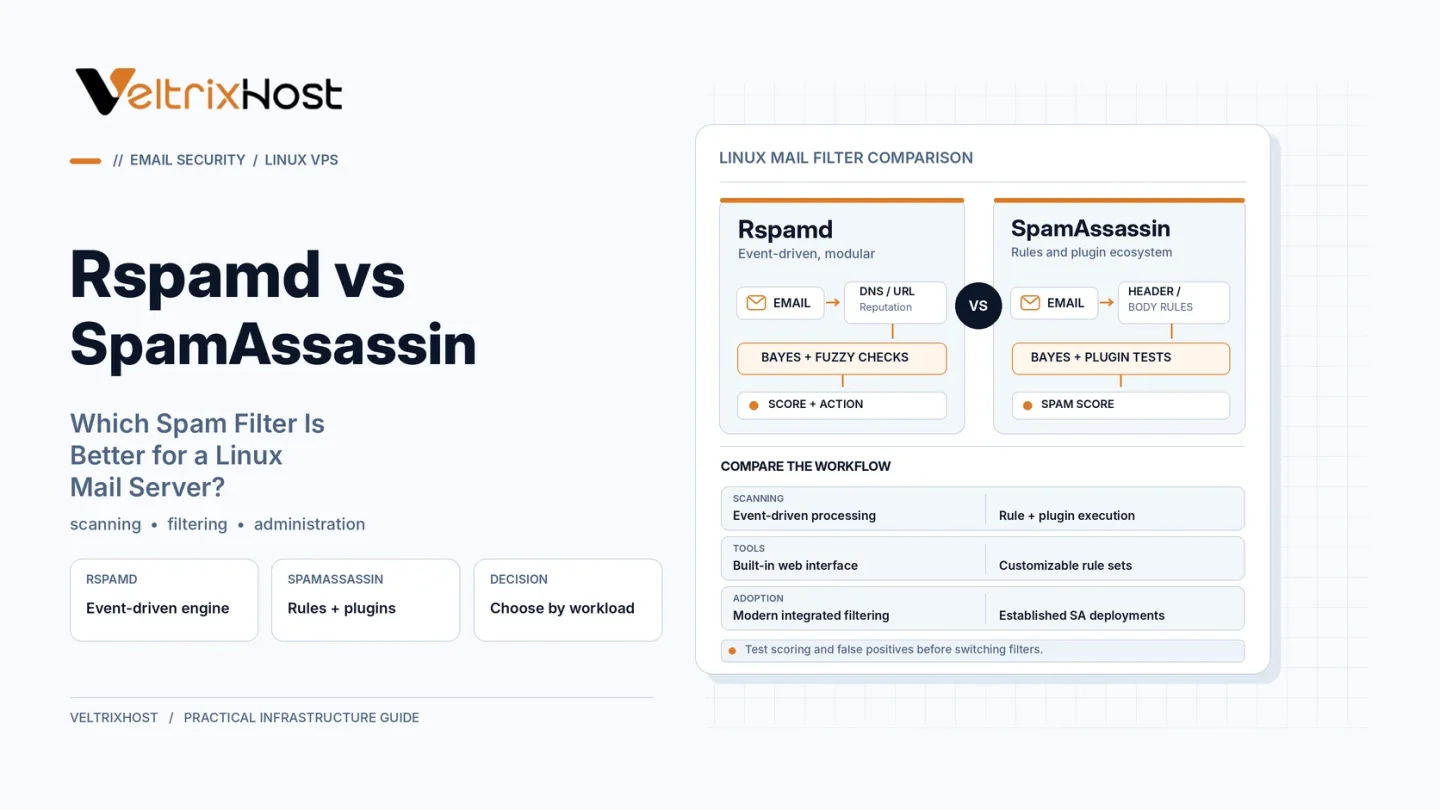
Choosing between Rspamd vs SpamAssassin affects how your Linux mail server detects unwanted messages, manages filtering rules, and uses CPU and RAM. Both analyze email for suspicious patterns, but their architectures and administration tools differ.
The best choice depends on incoming mail volume, your existing software, and how much control you need.
What Is Rspamd?
Rspamd is an event-driven email filtering system that works alongside a mail transfer agent such as Postfix or Exim. It scores messages using content rules, DNS blocklists, SPF, DKIM, DMARC, Bayesian learning, and optional neural analysis.
It also provides a web interface for reviewing filtering decisions. Some advanced functions, including persistent Bayesian learning and greylisting, need Redis.
What Is SpamAssassin?
Apache SpamAssassin uses rules, heuristic tests, reputation lookups, and Bayesian classification to identify suspected spam.
Administrators can customize scores and add plugins. It commonly runs through the spamd service and spamc client, with integration handled by the mail system.
Its mature rules ecosystem is useful when existing workflows already depend on SpamAssassin.
Rspamd vs SpamAssassin: Key Differences
| Feature | Rspamd | SpamAssassin |
|---|---|---|
| Processing design | Event-driven, asynchronous | Usually spamd worker processes |
| Spam detection | Rules, Bayes, optional neural checks | Rules, Bayes, plugins |
| Administration | Built-in web interface | Configuration files; external dashboards |
| Integration | Milter, APIs, Exim support | spamd/spamc, mail integrations |
| Extra services | Redis for some features | Depends on selected plugins |
| Best fit | Growing, busy mail systems | Existing rule-heavy setups |
Which Filter Is Faster?
Rspamd’s asynchronous processing can handle many simultaneous checks efficiently. It is often attractive for busy mail servers.
However, no universal throughput figure applies. Message size, enabled tests, DNS response times, CPU resources, and scanning configuration affect performance.
Benchmark both filters using representative messages before changing a production system.
Which Is Easier to Manage?
Rspamd’s dashboard makes it convenient to inspect scores and adjust filtering decisions. Review the official Rspamd documentation for its configuration and integration options.
SpamAssassin offers text-based rules and familiar administration workflows. If your hosting panel already manages SpamAssassin, replacing it may create unnecessary work.
Whichever you choose, tune rejection thresholds carefully to avoid blocking legitimate customer email.
Do You Need Spam Filtering on an SMTP VPS?
An outgoing-only SMTP relay may not need inbound mailbox spam filtering. Instead, focus on authenticated submission, relay restrictions, rate limits, logging, and outbound abuse controls.
If your VPS receives customer mailboxes, spam filtering becomes more important.
VeltrixHost SMTP VPS Hosting offers self-managed Linux servers with root access, outbound Port 25, and PTR/rDNS controls. Install the filtering stack your workload requires.
Final Recommendation
For Rspamd vs SpamAssassin, choose Rspamd when you want integrated visibility and efficient concurrent scanning. Keep SpamAssassin when its established rules and integrations already meet your needs.
Both require updates, monitoring, and regular false-positive reviews.
FAQs
Is Rspamd better than SpamAssassin for Postfix?
Either can work. Rspamd provides Milter integration, while SpamAssassin can be connected through compatible filtering services.
Does Rspamd require Redis?
Basic filtering works without it, but several learning and policy features rely on Redis.
Do spam filters guarantee email deliverability?
No. They help classify mail; authentication, sender reputation, and receiver policies still affect delivery.