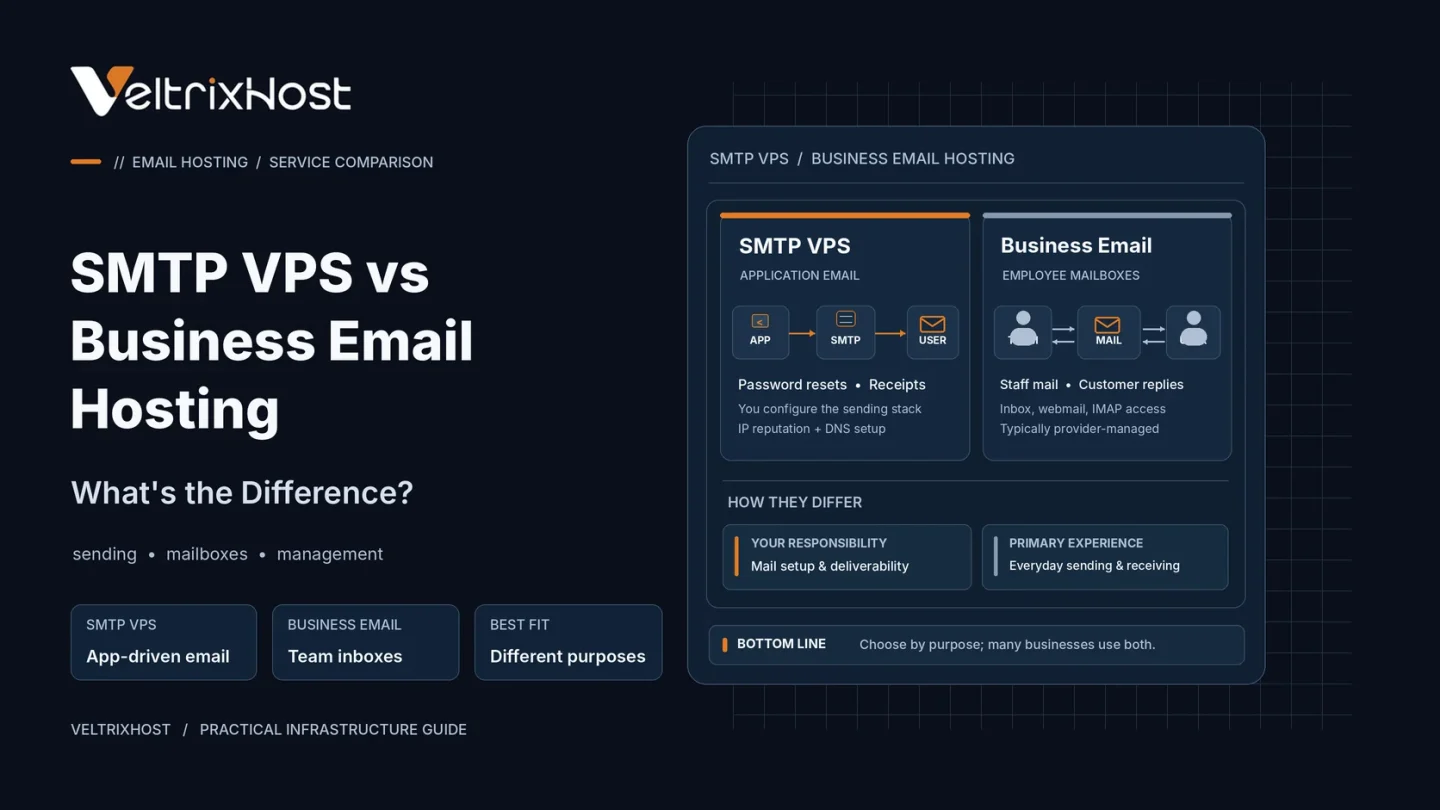
Choosing between SMTP VPS vs business email hosting depends on what you need email to do. An SMTP VPS gives you server-level control over sending infrastructure. Business email hosting focuses on ready-to-use mailboxes for employees.
Both can send messages, but their management responsibilities, costs, and typical workloads differ.
What Is an SMTP VPS?
An SMTP VPS is a virtual private server where you install and manage email software, such as Postfix or Exim.
You control server settings, outgoing queues, authentication, logging, and mail-routing policies. This makes it useful for application notifications, order receipts, and permission-based mailing.
However, an SMTP VPS does not automatically include employee inboxes, webmail, calendars, or spam filtering. You must install and maintain those components if needed.
What Is Business Email Hosting?
Business email hosting provides managed mailboxes using your company domain, such as sales@example.com.
Services commonly include webmail, mobile access, spam protection, and user administration. Some also offer shared calendars and collaboration tools.
For example, Microsoft Exchange Online provides hosted email, calendars, contacts, and administrative controls. Its official service description outlines the available features.
Business email hosting is designed primarily for people reading and replying to messages, although applications may also use supported submission methods.
SMTP VPS vs Business Email Hosting: Key Differences
| Feature | SMTP VPS | Business Email Hosting |
|---|---|---|
| Primary focus | Controlled sending infrastructure | Employee mailboxes |
| Server maintenance | Customer-managed | Provider-managed |
| Webmail and calendars | Require additional software | Often included |
| IP and queue control | Greater direct control | Usually limited |
| Pricing model | Server resources | Commonly per user |
| Best for | Applications and custom mail stacks | Everyday business communication |
When Should You Choose an SMTP VPS?
Choose an SMTP VPS when your team can manage Linux, DNS, security updates, and mail-server troubleshooting.
It may suit SaaS notifications, ecommerce receipts, self-hosted applications, or custom delivery workflows.
Before sending, configure SPF, DKIM, DMARC, reverse DNS, TLS, queue monitoring, and abuse prevention.
VeltrixHost SMTP VPS Hosting offers root access, dedicated IPv4 resources, outbound Port 25, and PTR/rDNS management for self-managed setups.
These features enable configuration flexibility, not guaranteed inbox placement.
When Is Business Email Hosting Better?
Choose managed business email when employees need dependable inbox access, shared calendars, mobile synchronization, and minimal server maintenance.
For a small office without a mail administrator, the subscription cost may be easier to justify than maintaining its own mail stack.
Can You Use Both Services?
Yes. A company can use business email hosting for employee conversations and an SMTP VPS for approved application notifications.
Configure sending domains carefully, maintain authentication, and monitor each service separately. An SMTP VPS is not a substitute for mailbox hosting unless you build and operate that capability.
Final Recommendation
In the SMTP VPS vs business email hosting comparison, choose managed mailboxes for everyday communication and a self-managed SMTP VPS when infrastructure control is essential.
Evaluate total administration effort alongside subscription or server costs.
FAQs
Does an SMTP VPS include business email accounts?
Not automatically. You need mailbox software and sufficient storage to host them.
Can business email hosting send automated messages?
Sometimes, within provider limits and supported application-integration methods.
Does a dedicated SMTP IP guarantee delivery?
No. Sender reputation, authentication, and recipient policies still affect delivery.