Choosing between bare metal vs virtual machine hosting affects server performance, hardware control, scalability, and operating costs. Both solutions can run websites, applications, databases, and demanding workloads.
However, dedicated physical hardware does not automatically outperform every virtual machine. The right choice depends on resource allocation, infrastructure quality, and application requirements.
What Is Bare Metal Hosting?
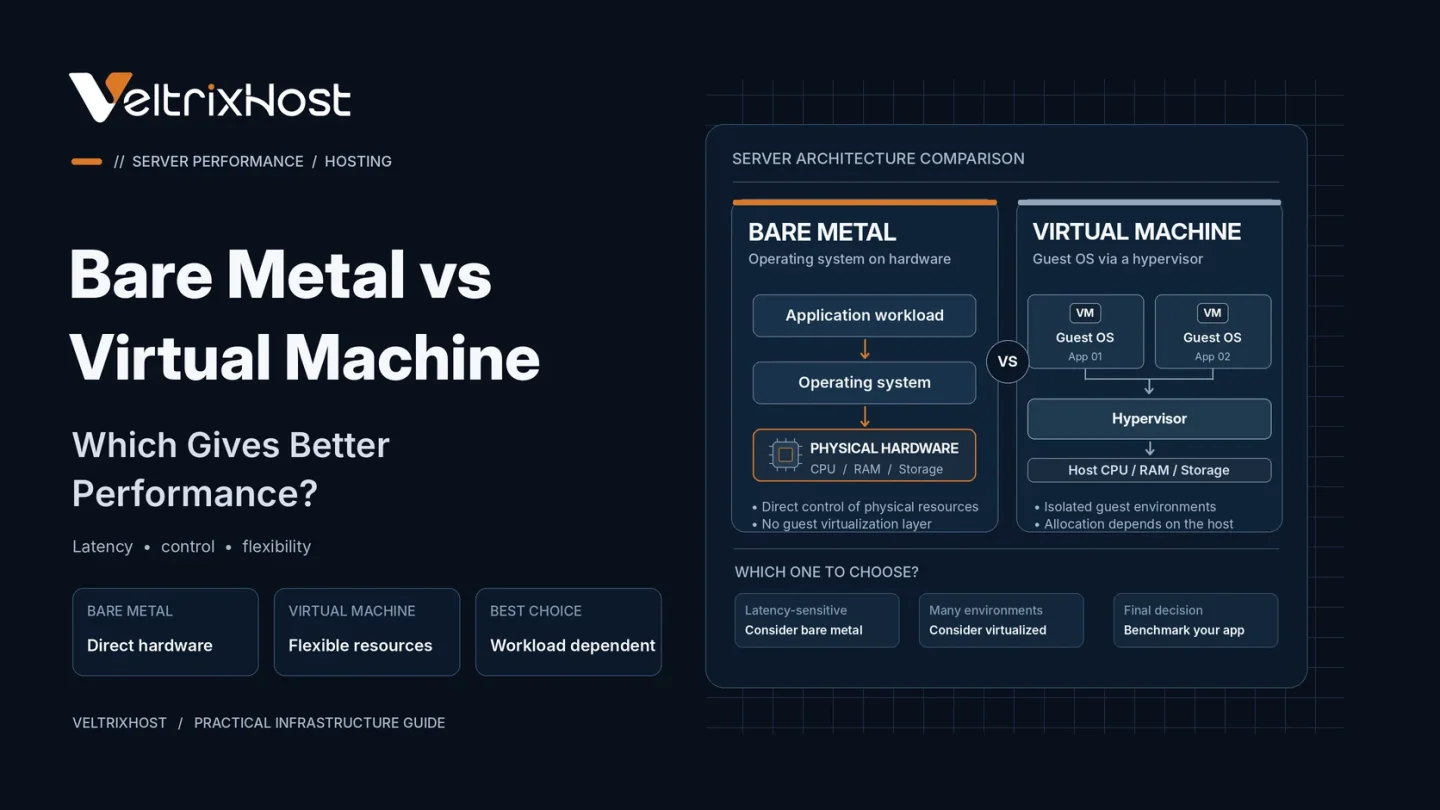
Bare metal hosting provides access to an entire physical server without requiring a virtualization layer.
The server’s CPU, RAM, and storage resources are assigned to one customer. As a result, businesses gain direct hardware control and avoid competing with unrelated virtual machines on the same host.
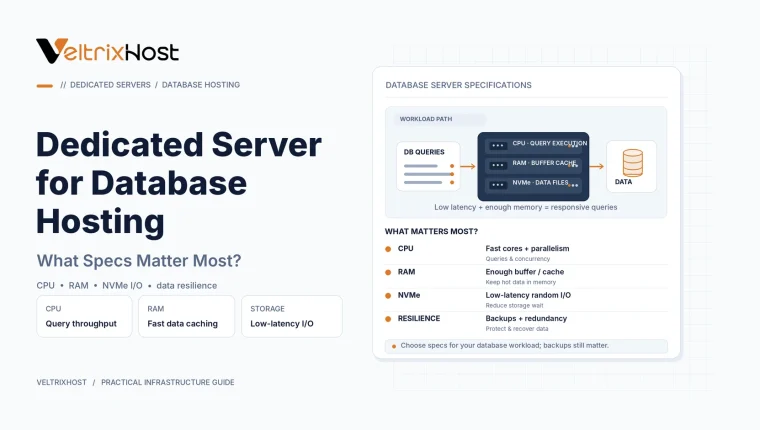
Bare metal is particularly useful for intensive databases, virtualization platforms, high-performance computing, and applications requiring specialized hardware.
What Is a Virtual Machine?
A virtual machine (VM) is a software-defined computing environment running on physical hardware through a hypervisor.
Technologies such as KVM and VMware allow multiple virtual machines to operate independently on one physical server.
Each VM receives allocated processing power, memory, and storage.
Virtualization also simplifies provisioning, migration, resource management, and infrastructure scaling.
Bare Metal vs Virtual Machine: Key Differences
| Feature | Bare Metal | Virtual Machine |
|---|---|---|
| Hardware access | Direct physical resources | Virtualized resources |
| CPU performance | Dedicated physical capacity | Depends on allocation |
| Resource isolation | Physical server isolation | Hypervisor isolation |
| Deployment | Often slower | Usually faster |
| Scalability | Hardware-dependent | Generally easier |
| Cost | Usually higher | Often lower |
| Best suited for | Demanding workloads | Flexible applications |
Which Offers Better CPU Performance?
Bare metal eliminates most hypervisor-related CPU scheduling overhead and provides direct control over physical processor resources.
However, modern hypervisors are highly efficient.
According to AWS performance guidance, properly configured virtualized instances can deliver performance nearly indistinguishable from bare-metal instances.
Therefore, CPU generation, clock speed, resource contention, and workload optimization often matter more than virtualization alone.
What About RAM and Storage Performance?
Bare metal provides direct access to installed memory and storage devices.
Virtual machines can also deliver excellent performance using optimized drivers, NVMe storage, and appropriate resource allocations.
However, oversubscribed hosts may experience performance variations when neighboring workloads compete for CPU or storage capacity.
A properly configured VM on modern hardware can outperform an older dedicated server.
When Should You Choose Bare Metal?
Consider bare metal when your applications require:
- Consistent, sustained processing capacity.
- Large databases or intensive storage operations.
- Specialized hardware or low-level system control.
- Multiple virtual machines on dedicated infrastructure.
For these workloads, VeltrixHost Dedicated Servers offer single-tenant hardware, full administrative access, and configurable storage and networking options.
When Is a Virtual Machine Better?
Virtual machines are practical for websites, development environments, APIs, staging servers, and applications requiring flexible resource allocation.
They generally offer lower entry costs and faster provisioning.
Additionally, virtualization can simplify testing, migrations, and infrastructure management.
Final Recommendation
In the bare metal vs virtual machine comparison, neither solution guarantees better performance.
Choose bare metal for predictable physical resources and specialized workloads. Choose virtual machines when flexibility, cost efficiency, and convenient scaling matter most.
Always compare actual benchmarks and resource specifications before purchasing.
FAQs
Is bare metal always faster than a VM?
No. Modern virtualization can deliver comparable performance, depending on hardware and configuration.
Does virtualization reduce CPU performance?
Some overhead may exist, but efficient hypervisors can minimize its impact.
Is bare metal better for databases?
It can benefit demanding databases requiring predictable CPU, memory, and storage performance.
Can bare metal run virtual machines?
Yes. You can install virtualization platforms such as Proxmox or KVM on compatible dedicated hardware.