A dedicated server for CDN origin hosting can support websites, streaming platforms, and applications that deliver large amounts of content. However, not every project needs dedicated hardware behind its content delivery network (CDN).
The right decision depends on origin traffic, cache efficiency, storage requirements, and infrastructure costs.
What Is a CDN Origin Server?
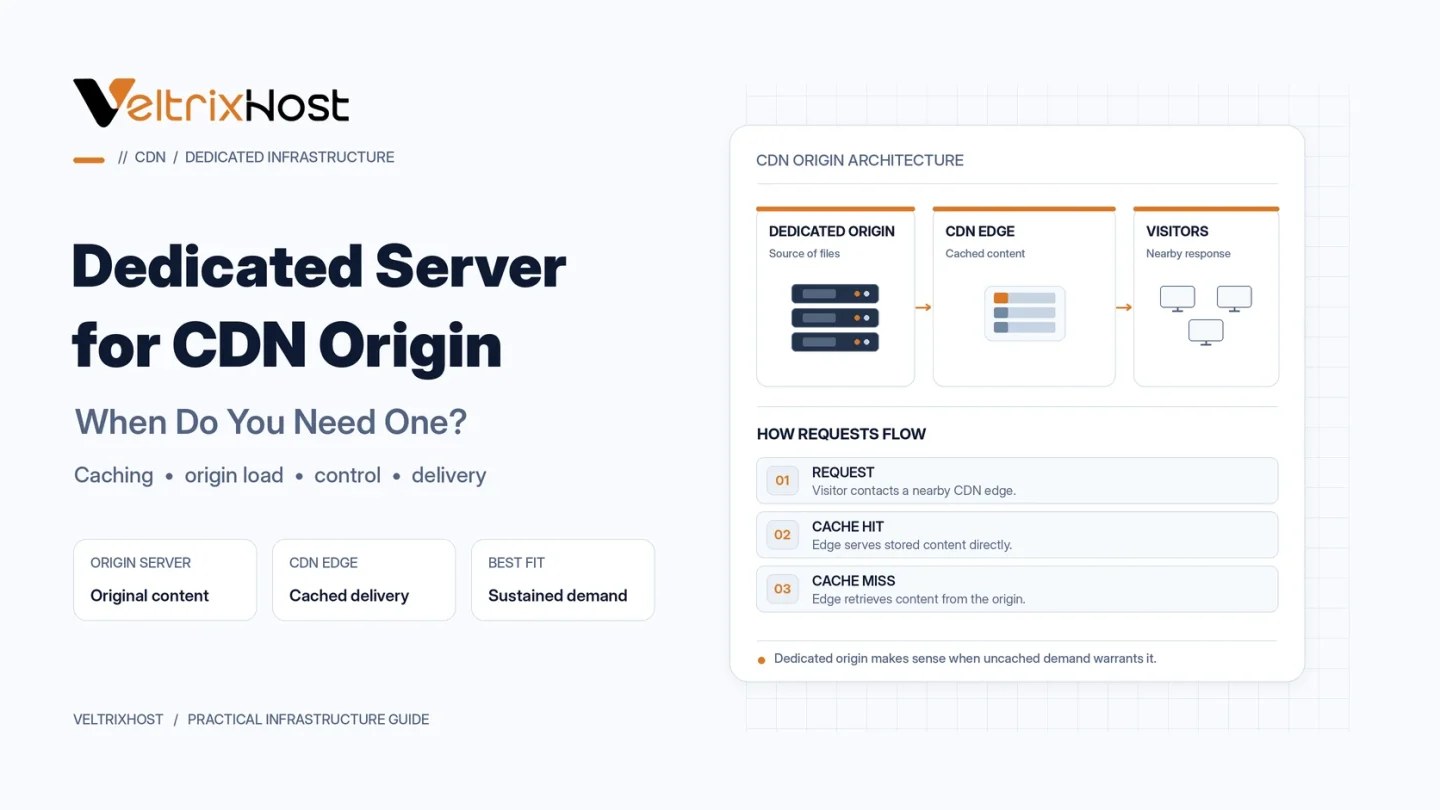
A CDN origin server stores or generates the original content delivered through a CDN.
When visitors request cached files, nearby CDN edge servers can respond without contacting the origin.
However, cache misses, expired content, and uncached requests must reach the origin. Therefore, the origin still needs sufficient processing power, storage, and network capacity.
How Does a Dedicated Server for CDN Origin Work?
A dedicated origin uses physical hardware reserved for one customer rather than sharing a virtual machine host.
It can store website assets, software downloads, video files, or dynamically generated content.
The CDN retrieves this information from the dedicated server and distributes eligible cached copies through its edge network.
Dedicated hardware provides greater resource control, although performance still depends on network quality and server configuration.
When Do You Need a Dedicated CDN Origin?
Consider upgrading when your existing origin consistently experiences these problems.
1. Heavy Origin Traffic
A high-traffic website with frequent cache misses may generate substantial requests to its origin.
Dedicated CPU resources and sufficient RAM can help maintain consistent performance.
2. Large Media and Download Libraries
Video platforms, game downloads, and file distribution services may require substantial storage and sustained transfer capacity.
NVMe or SSD storage can help with intensive file operations.
3. High Network Throughput
When origin transfers approach your current port capacity, higher-bandwidth connectivity may become valuable.
However, a 10Gbps port does not automatically provide unlimited monthly data transfer.
4. Resource-Intensive Applications
Dynamic APIs, image processing, and content-generation workloads may benefit from predictable CPU and memory availability.
VPS vs Dedicated Server for CDN Origin
| Requirement | VPS Origin | Dedicated Origin |
|---|---|---|
| Hardware | Virtualized resources | Single-tenant server |
| Initial cost | Usually lower | Usually higher |
| CPU and RAM | Plan-dependent | Dedicated hardware |
| Storage capacity | Often smaller | Larger options |
| Network options | Provider-dependent | High-bandwidth options |
| Best suited for | Smaller origins | Demanding workloads |
A well-configured VPS may still be sufficient when CDN caching absorbs most requests.
What Specifications Matter Most?
Evaluate peak origin requests, cache-hit ratio, CPU usage, RAM, storage performance, and outgoing traffic.
Also consider server location, network routing, backup arrangements, and DDoS protection.
Before purchasing, check whether better caching could solve the bottleneck.
Amazon explains how additional caching layers can reduce origin requests in its CloudFront Origin Shield documentation.
Choosing a Dedicated CDN Origin Server
For larger workloads, compare VeltrixHost Dedicated Servers, including available CPU, storage, location, and network configurations.
Choose capacity according to measured origin demand rather than total CDN visitor traffic.
Restrict direct origin access where practical and maintain monitoring and independent backups.
Final Recommendation
A dedicated CDN origin server makes sense when a VPS cannot reliably handle origin requests, storage requirements, or network throughput.
First optimize caching. Then upgrade when monitoring shows that dedicated resources will address an actual limitation.
FAQs
Does every CDN need a dedicated server?
No. Many websites operate successfully with VPS or cloud origins.
Is 10Gbps necessary for CDN origin hosting?
Only when sustained or peak origin throughput justifies the additional capacity.
Can a dedicated origin improve website speed?
Yes, if origin processing or network performance is limiting requests. Cached responses depend mainly on CDN delivery.
Does a CDN replace origin backups?
No. CDN caches are not a substitute for recoverable backups of original content.