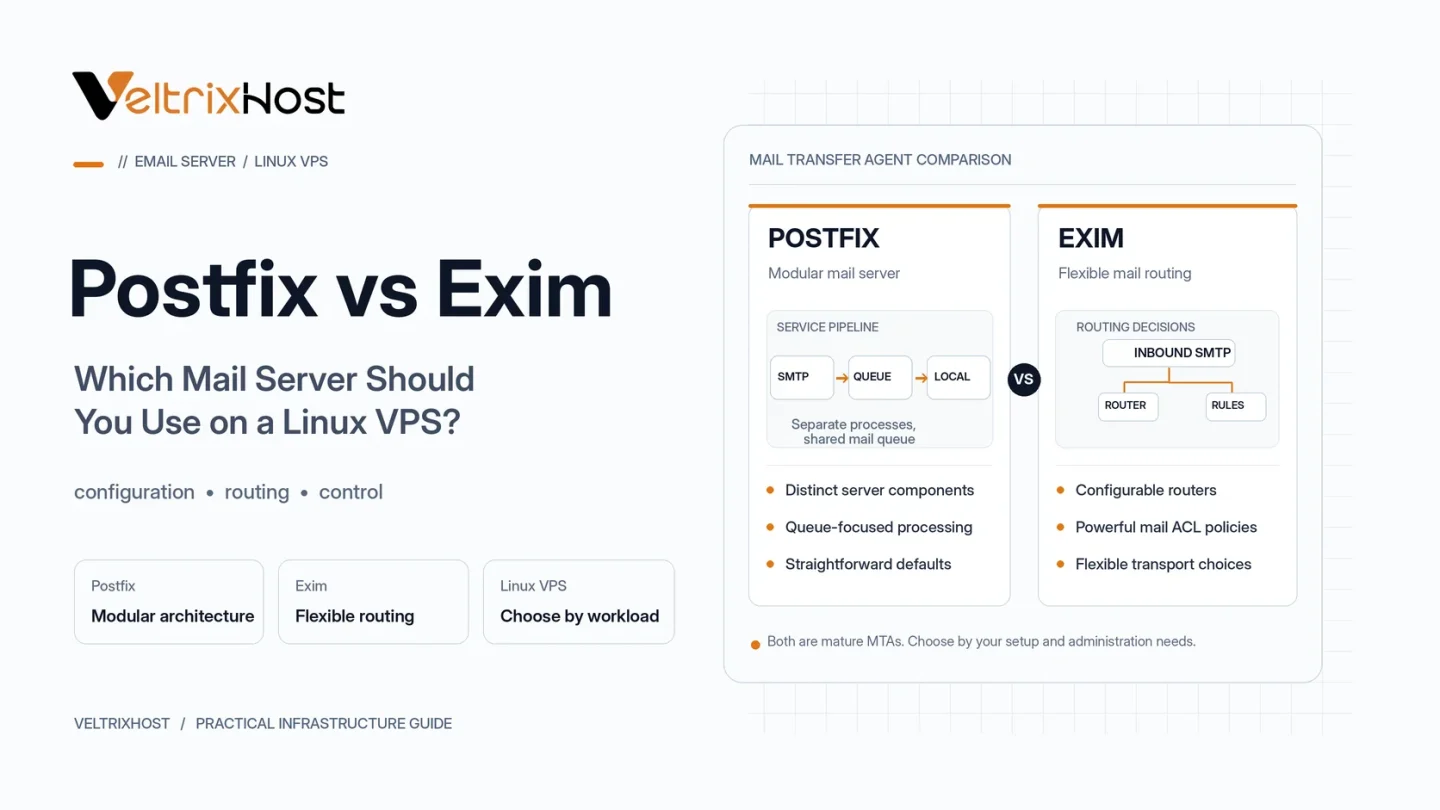
Choosing between Postfix vs Exim is an important decision when configuring a Linux VPS for email hosting. Both are established mail transfer agents (MTAs) that send, receive, and route email using SMTP.
However, they differ in configuration style, message routing, and administrative flexibility. Understanding these differences helps you select the right software for your mail server.
What Is Postfix?
Postfix is an open-source mail transfer agent designed with a modular architecture and security-focused processes.
It uses configuration files such as main.cf and master.cf to manage SMTP services, delivery rules, authentication, and other settings.
Postfix supports TLS, virtual domains, SMTP authentication, and external filtering integrations.
Its modular design and straightforward basic configuration make it a practical option for administrators building independent Linux mail servers.
What Is Exim?
Exim is another open-source mail transfer agent commonly used on Linux servers, particularly in cPanel-based hosting environments.
Its configuration system provides detailed control over message routing, transports, authentication, and access control lists (ACLs).
This flexibility is useful for shared hosting providers and administrators managing complicated email-routing requirements.
However, advanced Exim configurations can require more experience to maintain correctly.
Postfix vs Exim: Key Differences
| Feature | Postfix | Exim |
|---|---|---|
| Architecture | Modular processes | Highly configurable MTA |
| Configuration | main.cf, master.cf | Section-based configuration |
| Mail routing | Transport maps and policies | Routers and transports |
| Security | Privilege separation and controls | ACLs and security controls |
| Hosting panels | Common in independent stacks | Standard in cPanel/WHM |
| Best suited for | Standalone SMTP servers | Complex hosting environments |
Both support secure SMTP operation when properly configured and maintained.
Which Mail Server Offers Better Performance?
Neither Postfix nor Exim is automatically faster in every situation.
Actual performance depends on CPU resources, available RAM, storage speed, concurrent connections, queue sizes, DNS responsiveness, and filtering workloads.
Postfix uses a dedicated queue manager with separate incoming, active, and deferred queues. Exim provides configurable delivery and retry mechanisms.
For production deployments, monitor queue growth, delivery delays, and resource usage rather than relying on theoretical speed comparisons.
Which Is Easier to Configure?
Postfix is often easier to approach for a basic standalone SMTP setup because its common configuration options are well documented.
Exim offers extensive customization through routers, transports, and ACLs. These features can be valuable but introduce additional configuration complexity.
You can explore installation options through the official Postfix documentation.
If your VPS runs cPanel/WHM, retaining its supported Exim integration is generally preferable to replacing the mail system.
What Should You Check Before Installation?
Before deploying either mail server, verify these requirements:
- Outbound SMTP connectivity, including Port 25 where required.
- Dedicated IP address and PTR/rDNS configuration.
- SPF, DKIM, and DMARC authentication.
- TLS certificates and SMTP authentication.
- Queue monitoring, logs, and abuse protection.
For a self-managed environment, consider VeltrixHost SMTP VPS Hosting, which provides Linux root access, Port 25 connectivity, and PTR/rDNS management.
Final Recommendation
Choose Postfix for a straightforward, independently managed Linux SMTP server.
Choose Exim when you need detailed routing controls or operate an existing cPanel hosting environment.
Both can support reliable email infrastructure. Correct configuration, server security, and sender reputation matter more than the software name.
FAQs
Is Postfix better than Exim?
Postfix is often convenient for standalone setups, while Exim offers extensive routing customization. Neither is universally better.
Does cPanel use Postfix or Exim?
cPanel/WHM uses Exim as its mail transfer agent.
Can Postfix and Exim run together?
They can be installed on the same system, but they cannot both bind to the same SMTP port and IP address simultaneously.
Does Postfix improve email deliverability?
Not automatically. DNS authentication, IP reputation, recipient policies, and responsible sending practices influence deliverability.